Tell us about the job
Takes about a minute. No obligation.
A heat pump repair quote in Livingston County starts with what the equipment has actually been asked to carry over its life. 127 severe weather events were recorded in Livingston County, Michigan between 2015 and 2024. At that rate, severe weather is a real operating condition, but it sits somewhere in the middle of the range: present enough that a contractor checks for weather-related wear, not so relentless that it overrides every other explanation. Refrigerant loss, worn contactors, and failing capacitors trace more often to age and service history than to storm load. A contractor will establish which it is before recommending parts.
Half the homes in Livingston County, Michigan were built in 1991 or earlier (2020-2024 ACS 5-year). A heat pump sitting inside a house that age has almost certainly been replaced at least once, which means the refrigerant circuit, the reversing valve, and the control board a contractor opens today belong to a different generation than the house itself. What decides the repair is whether the manufacturer still makes the part the opened system needs. For refrigerant components and control boards on units that predate current product lines, a contractor sources what the equipment actually requires before the quote is firm.
The Parts of a Heat Pump a Contractor Checks First
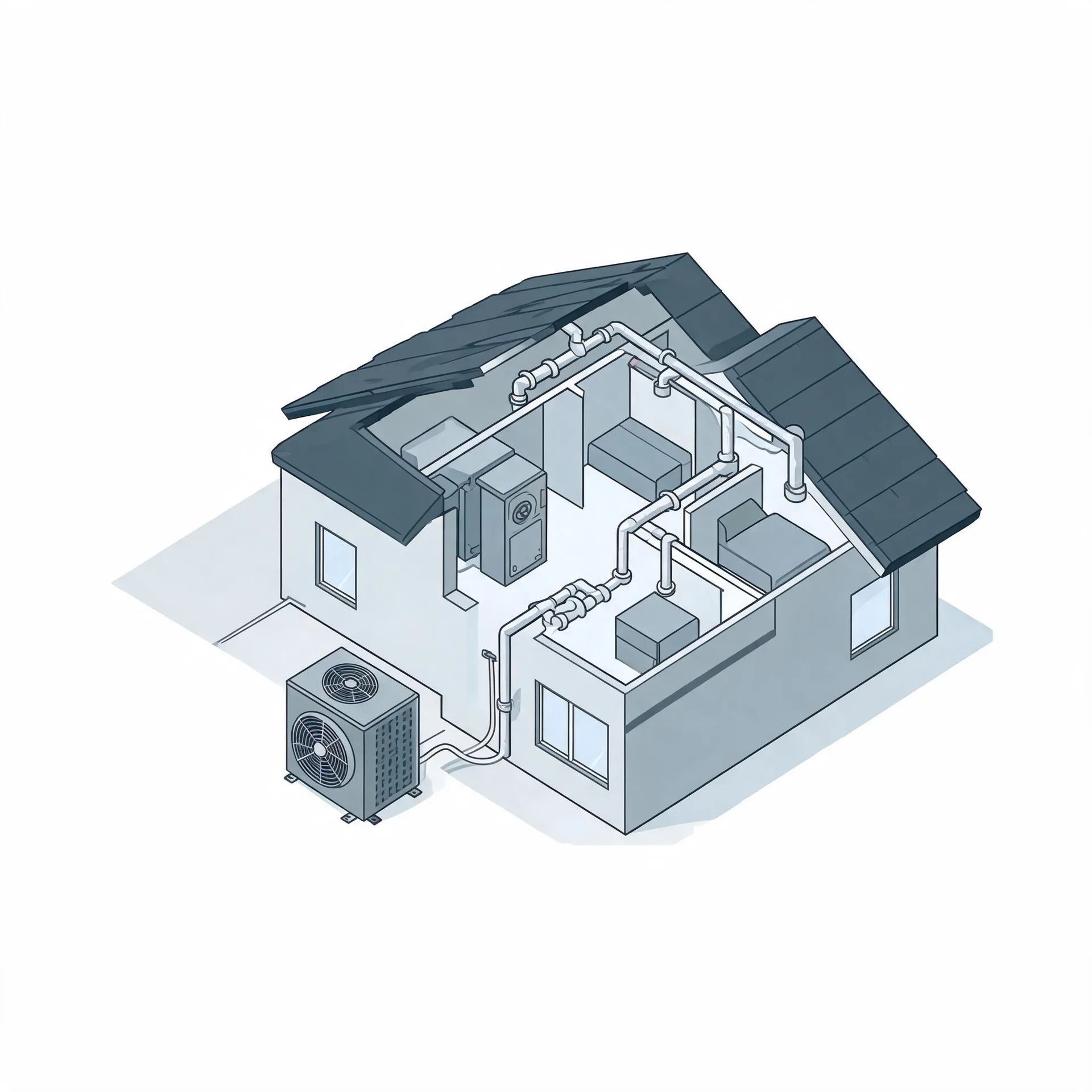
The outdoor unit sits on a pad beside the house and holds the compressor and the condenser coil. The compressor is where a contractor looks first when a heat pump stops moving heat properly, because it is the part under the most constant mechanical stress. The condenser coil and the fan that pulls air across it are checked alongside it, since a dirty or damaged coil will push the compressor toward failure.
The air handler lives inside the house, usually in a utility closet, basement, or attic, and it circulates conditioned air through the home. It contains the evaporator coil, the blower motor, and the reversing valve, which is the part that lets a heat pump both heat and cool. A refrigerant line set connects the two units, and a leak anywhere along it affects the whole system.
The drawing shows a general layout of these components, and a licensed contractor determines which parts apply and what work is needed in your specific home.
Find a contractor in Livingston CountyLivingston County, by the numbers
127 severe weather events were recorded in Livingston County, Michigan between 2015 and 2024.
NOAA National Centers for Environmental Information, Storm Events Database, bulk CSV export, events 2015-01-01 through 2024-12-31.Half the homes in Livingston County, Michigan were built in 1991 or earlier (2020-2024 ACS 5-year).
U.S. Census Bureau, 2020-2024 American Community Survey 5-Year EstimatesLivingston County, Michigan holds 80,367 housing units (2020-2024 ACS 5-year).
U.S. Census Bureau, 2020-2024 American Community Survey 5-Year EstimatesOwners occupy 86.9% of the occupied homes in Livingston County, Michigan (2020-2024 ACS 5-year).
U.S. Census Bureau, 2020-2024 American Community Survey 5-Year EstimatesCodes & Standards for Heat Pump Repair in Livingston County, Michigan2 sourced rules & standards
Licensing and Legal Requirements in Livingston County, Michigan
Michigan issues the mechanical contractor’s licence by classification: HVAC equipment, ductwork, refrigeration, hydronic heating and cooling, and limited or unlimited heating and refrigeration service are each a separate classification a contractor has to hold.
Michigan requires a mechanical contractor’s licence: nobody may install, alter or service the regulated mechanical work unless they, or an employee, hold a licence from the department that has not been revoked or suspended.
Severe Weather Events in Livingston County
Extreme weather puts heat pumps under strain, and how hard equipment works over time shapes what repairs it eventually needs. This chart shows the recorded severe weather load in the county so you can see what local systems are up against.
127 severe weather events, 2015–2024. Source: NOAA National Centers for Environmental Information, Storm Events Database.